

Over the last several months, I’ve spent a tremendous amount of time speaking with developers, founders, enterprise architects, students, and technology leaders about AI, and one thing has become very obvious to me: most developers are still thinking too small about what AI actually means for their future.
Many developers are focused almost entirely on AI coding assistants, prompt engineering, or generating snippets of code faster, but the real opportunity is significantly larger than that.
We are entering a completely new era of software where applications are no longer static systems waiting for human instructions. Software is becoming intelligent, autonomous, context-aware, and increasingly capable of executing workflows on behalf of humans.
That changes the role of developers completely.
For decades, developers primarily built systems that stored data, processed requests, rendered interfaces, and automated predefined business logic. The human user remained at the center of every operational workflow.
Now, AI agents are introducing a completely different model.
- Software can reason.
- Software can make decisions.
- Software can coordinate tasks.
- Software can interact with tools and APIs.
- Software can increasingly execute workflows autonomously.
That is not just another technology trend. That is a new computing paradigm.
The Biggest Misunderstanding Developers Have About AI
One of the biggest misconceptions I continue to see is the belief that AI is mainly about replacing coding or generating code faster. That is only a tiny piece of the opportunity.
The real transformation is happening because AI systems are moving beyond assistance and into execution.
A chatbot answers questions.
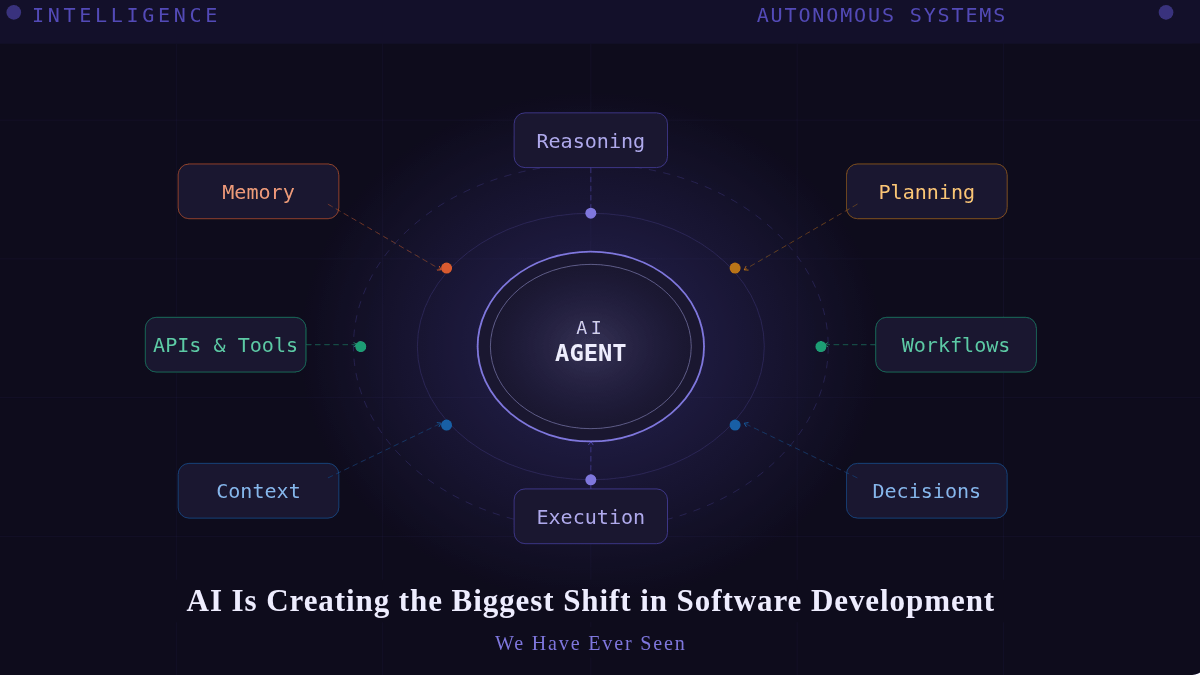
An AI agent can:
• Understand goals
• Analyze context
• Access tools
• Interact with systems
• Coordinate workflows
• Make decisions
• Continue tasks autonomously
Historically, software waited for commands. AI agents can increasingly pursue objectives.
That changes how software systems are designed from the ground up.
Developers Are No Longer Just Writing Software
This is the most important shift developers need to understand. The role of developers is evolving from writing applications to designing intelligent systems. That is a much bigger opportunity.
The developers who thrive over the next decade will not simply be the people who write syntax the fastest. They will be the people who understand how to orchestrate intelligence across systems, workflows, APIs, data, and autonomous agents.
In many ways, developers are becoming architects of intelligence.
That means understanding:
• Agentic workflows
• Multi-agent systems
• Context engineering
• AI orchestration
• Memory systems
• Autonomous execution
• AI infrastructure
• Tool integration
• Human and AI collaboration models
These are becoming foundational software engineering skills.
The Real Opportunity Is Workflow Intelligence
I believe the biggest opportunity in AI for developers is not building another chatbot.
The real opportunity is identifying repetitive workflows humans perform every single day and transforming those workflows into intelligent autonomous systems.
That is where massive value will be created.
- Every company has operational friction.
- Every organization has repetitive coordination work.
- Every startup has bottlenecks caused by manual workflows.
AI agents are becoming the systems that remove that friction.
Imagine a startup where an AI agent:
• Handles customer support workflows
• Updates CRM systems automatically
• Summarizes meetings
• Generates reports
• Monitors infrastructure
• Coordinates internal operations
• Researches competitors
• Drafts follow-ups
• Schedules meetings
• Escalates issues intelligently
That is not science fiction anymore. That is already happening.
Real Companies Already Building This Future
Many of the world’s leading technology companies are aggressively moving toward AI agents and autonomous systems because they clearly understand where the industry is heading.
🔹 OpenAI
OpenAI is evolving beyond conversational interfaces into systems capable of reasoning, memory, workflow execution, and tool interaction. Developers are already building AI agents on top of OpenAI models that automate engineering workflows, operations, support systems, and business processes.
Anthropic
Anthropic has focused heavily on long context reasoning, tool usage, coding workflows, and collaborative AI systems. Claude is increasingly being used for engineering assistance, operational coordination, research, and enterprise productivity workflows.
Microsoft
Microsoft is embedding AI copilots and autonomous workflows across enterprise software, developer tooling, cloud systems, Office applications, and business operations because they understand that intelligent software systems will become standard infrastructure.
Salesforce
Salesforce is aggressively positioning AI agents and digital labor as the future of customer operations, CRM workflows, and enterprise automation.
Klarna
Klarna publicly shared that its AI assistant was handling work equivalent to hundreds of customer support agents while improving operational efficiency and response times. Regardless of exact metrics, the broader industry trend is undeniable: enterprises are restructuring workflows around AI agents.
Why Small Teams Will Become Extremely Powerful
Historically, scaling software companies required larger operational teams.
More growth usually meant:
• More support staff
• More coordinators
• More operations teams
• More analysts
AI agents dramatically change this equation.
Small teams can now operate with the leverage that previously required entire departments. A startup with a handful of developers and well-designed AI agents can execute faster than much larger organizations from only a few years ago.
This is one reason why many people now believe we are entering the era of AI native companies and potentially even one-person billion-dollar businesses.
Not because one person literally does everything alone. But because AI dramatically amplifies human capability.
Also read | How Google AI Search Works: A Simple Guide for Everyday Users
What Developers Should Learn Right Now
The developers who will dominate the next decade are not just learning frameworks. They are learning how intelligent systems operate.
I strongly believe developers should start focusing on:
AI Agent Architectures
How agents reason, plan, and execute workflows.
Context Engineering
One of the most underrated skills in AI today.
Multi-Agent Systems
How multiple AI systems collaborate.
AI Infrastructure
Models, vector databases, orchestration, APIs, memory, and observability.
Human and AI Collaboration
Understanding where humans remain critical and where AI creates leverage.
Product Thinking
Developers who understand business workflows will build the most valuable AI systems.
The developers who combine engineering skill with workflow intelligence and AI orchestration will become incredibly valuable.
AI Will Not Replace Great Developers
There is a lot of fear right now around AI replacing developers. Personally, I think most of that conversation misses the point. AI will absolutely automate portions of software development. But the demand for intelligent systems is exploding so rapidly that developers who learn how to build AI native systems will likely become even more valuable.
The real risk is not AI replacing developers. The real risk is developers refusing to evolve.
Developers who learn AI workflows, orchestration, autonomous systems, and intelligent architectures will move dramatically faster than those who continue building software exactly the same way they did five years ago.
Final Thoughts
I genuinely believe we are still incredibly early in the AI era. Most businesses today are barely scratching the surface of what AI agents and autonomous systems can actually do, but the direction is becoming increasingly obvious.
Over the next five years:
• Every software product will include AI
• Every enterprise workflow will include automation
• Every developer will collaborate with AI systems
• AI native startups will emerge everywhere
• Autonomous agents will become standard infrastructure
We are moving from software tools to intelligent digital workers. That is one of the biggest technology opportunities developers have ever seen. The developers who embrace this shift early will help build the next generation of software, startups, and intelligent systems. And honestly, I believe we are only getting started.