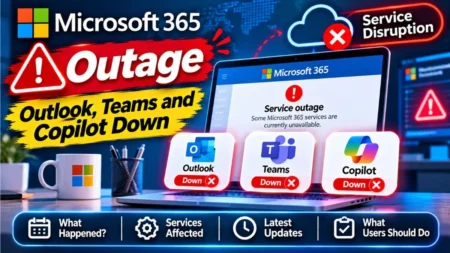
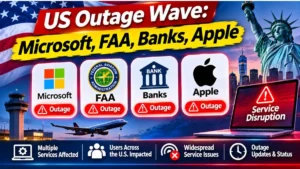


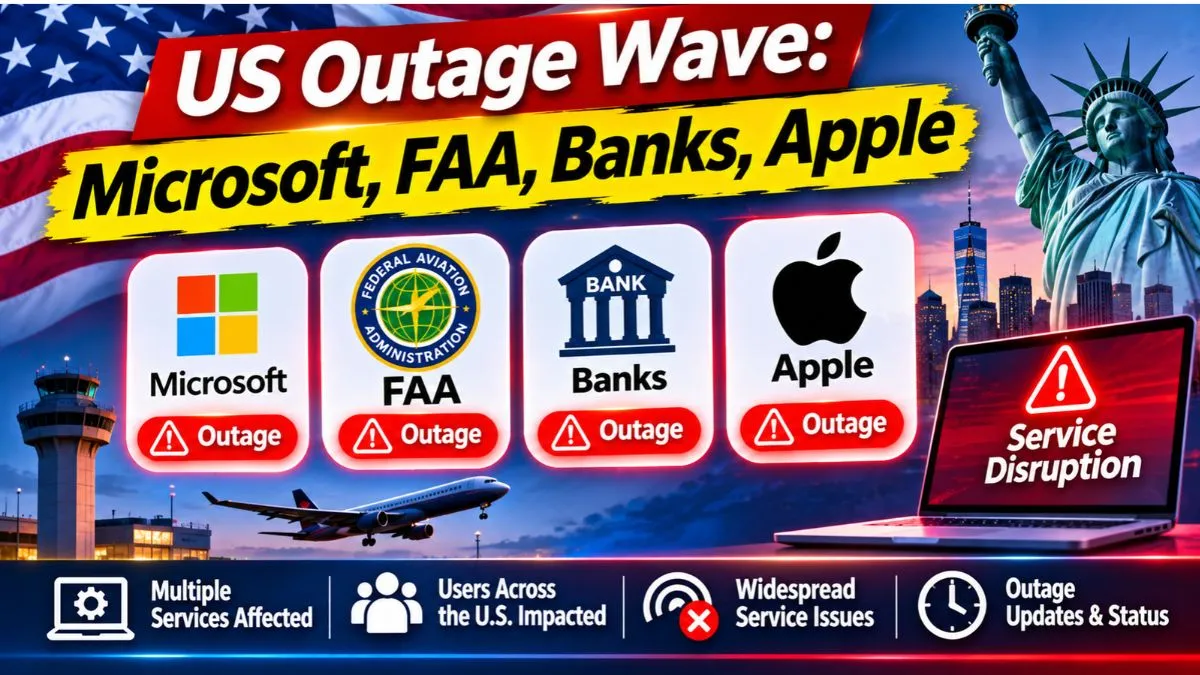
A string of US outages hit major companies and government systems in just six days, from November 12 to 17, 2026. Microsoft’s email and Teams went down, the FAA ordered a nationwide flight stop, United Airlines grounded departures, a software bug disrupted Chase and other banks, Apple services failed and Marriott’s sign-in broke. Officials say the incidents appear unrelated and they have found no evidence of a coordinated cyberattack, but the causes cited so far point to a common theme: changes and maintenance gone wrong. This guide explains each outage, what we know and how to protect yourself next time.
Quick facts
- Six days, many systems: Microsoft 365 (Nov 12 to 14), the FAA (Nov 13), United Airlines and major banks (Nov 16), and Apple, Marriott and the NSA (Nov 17).
- Cyberattack? Companies and officials say no for each incident they have commented on, and the incidents appear unrelated.
- Common thread in the causes cited so far: a network change, a newly installed router, a software bug, an internal update and routine maintenance. This is our reading of the public statements, not an official finding.
- Biggest impact on travel: the FAA’s nationwide ground stop on Friday, November 13, which the National Desk reports was the third in the agency’s history.
- Biggest impact on money: online banking and Zelle problems at several large banks on Monday, November 16, after Chase said a software bug affected its systems.
- Status: companies say Microsoft, United, the FAA and Chase services have been restored. Investigations and final reports are still pending.
Want fast tech and cybersecurity updates in simple language? Join the Infovistar WhatsApp channel and never miss a new guide.
Timeline: what happened and when
| Date | Who | What happened | Cause cited so far | Cyberattack? |
|---|---|---|---|---|
| Thu Nov 12 to Sat Nov 14 | Microsoft 365 | Outlook, Teams, Copilot and other services down for more than 24 hours | An issue from an earlier network capacity upgrade that surfaced after a recent network change | Microsoft says no, and not related to AI |
| Fri Nov 13 | FAA | Nationwide flight ground stop that lasted several hours | Technicians linked it to a Juniper router installed at a facility in Arkansas. Root cause still under investigation | Not indicated in the reports we checked |
| Mon Nov 16 | United Airlines | Technology outage of more than 90 minutes delayed departures | Root cause not yet public | United says no indication it was cyber-related |
| Mon Nov 16 | Chase and other banks | Customers had trouble with online banking, ATMs and Zelle | Chase said a software bug affected its systems | Chase says no |
| Tue Nov 17 | Apple | Outage affecting iCloud sign-in, App Store, Apple Pay, Apple Music and support | Apple says an internal update | Apple says no |
| Tue Nov 17 | Marriott | Sign-in problems on Marriott.com and the Bonvoy app | Technical issue; Marriott found no sign it was cybersecurity-related | Marriott says no |
| Reported Nov 17 | NSA | Temporary degradation of internal systems | An NSA spokesperson said it happened during scheduled routine maintenance | No indication given |
Incident by incident
Microsoft 365 (November 12 to 14)
Microsoft’s email service (Exchange Online), Teams, SharePoint, Copilot and other Microsoft 365 services failed on Thursday afternoon. Downdetector showed about 130,000 Outlook problem reports at the start, and the disruption lasted more than 24 hours. Hospitals, universities and transport services in North America reported effects.
Microsoft said the incident came from “an issue during an earlier network capacity upgrade that surfaced following a recent network change.” Reports citing Microsoft’s explanation said the trouble started after Teams moved onto the same network that powers Exchange Online, at a time when about 14% of server capacity was offline for unrelated maintenance. Microsoft said it was not a cyber incident and not related to AI. It apologised and promised a full post-incident report. For the full timeline, see our earlier guide on the Microsoft 365 outage.
FAA nationwide ground stop (November 13)
The Federal Aviation Administration stopped flights across the country on Friday for several hours. The National Desk reports this was the third nationwide ground stop in the agency’s history. The FAA said technicians linked the disruption to a Juniper router installed at a facility in Arkansas, though the root cause was still being investigated. An FAA spokesperson said the agency paused new installations of that equipment and disabled those already installed. Transportation Secretary Sean Duffy blamed a lack of funding for upgrades to an outdated air system. Many passengers were stranded and had to rebook.
United Airlines (November 16)
On Monday, a United technology outage lasting more than 90 minutes delayed departing flights. Flights already in the air and United Express regional flights were not affected. A pilots’ union memo seen by Reuters said a companywide web-based outage hit applications pilots use, including crew communications. By midnight Eastern time, FlightAware showed 851 delayed and 51 cancelled United flights. United said there was no indication that it was a cybersecurity issue.
Chase and other major banks (November 16)
Customers at several of the largest US banks reported trouble reaching their accounts on Monday. Downdetector showed spikes for JPMorgan Chase, Bank of America, U.S. Bank, Truist and Wells Fargo, plus reports of problems with the payments app Zelle. Bank of America customers reported ATM, online and mobile problems. Chase said a software bug was affecting its systems and that it was not a cyberattack. Capital One said it was not affected. Some customers saw a message saying some services were not available. CBS News reported on Tuesday that the widespread disruption appeared to be over.
Apple (November 17)
Thousands of users reported problems with Apple services on Tuesday, including iCloud sign-in, the App Store, Apple Pay, Apple Music and Apple Support. Apple said an internal update caused the outage and that it was not a cyberattack.
Marriott (November 17)
Marriott said it resolved a technical issue that affected sign-in on Marriott.com and the Marriott Bonvoy app, disrupting some bookings. A company review found no sign it was cybersecurity-related.
NSA (reported November 17)
An NSA spokesperson said the agency “experienced temporary degradation during scheduled routine maintenance,” according to local news reports quoting the statement. It is unusual for such an incident to become public, and it drew attention because it came during the same week as the other outages.
Are the outages connected?
Officials told reporters that the incidents appear unrelated, and they have found no evidence of a coordinated cyberattack. Here is how to think about it:
- No proof of a single cause. The companies are different, the systems are different and the causes they cite are different.
- A pattern, not a plot. Several causes involve changes: a network change, a new router, a software bug, an internal update and maintenance. That points to change management and complexity, not necessarily to attackers.
- Timing can be coincidence. Big systems fail all the time. A busy news week makes them look linked.
- Keep an open mind. Final reports may add details, so avoid claims that are not backed by official statements.
A security analyst quoted by local news suggested that organisations often tighten networks before the holidays. That is an opinion, not an official explanation.
Why big outages happen
- Changes are risky. Upgrades, patches and maintenance are the most common reasons a stable system fails.
- Systems depend on each other. One service relies on another, so a small fault can spread.
- Few providers carry a lot of traffic. When one large cloud, network or payment system fails, many companies feel it at once.
- Old systems and tight budgets. Government and industry officials have pointed to outdated systems and funding gaps, as the Transportation Secretary did for air traffic systems.
- Rollbacks are hard. Undoing a change at huge scale can take hours.
- Human error and testing gaps. Even careful teams miss edge cases.
What it means for you
For travellers
- Check your airline app and the FAA or airport website before you leave.
- Keep your booking details, hotel info and ID available offline.
- Know your rights to a refund or rebooking for cancellations, and keep receipts.
Bank customers
- Keep a second payment method: another bank’s card, some cash or a different app.
- Do not repeatedly try to log in during an outage, because it can lock you out.
- Check your account later for duplicate or missing transactions.
- Use only the bank’s official app or website, never links in messages. Scammers love outages. See our guides on how to identify a fake text message and OTP scams in India.
If you use Apple, Microsoft or other cloud services
- Keep important files, photos and contacts backed up in more than one place.
- Do not reset passwords during an outage unless you suspect a real compromise.
- Check the company’s official status page before you try fixes.
If you run a business
- Write a short outage plan: who decides, who tells staff and customers, and which backup tools you use.
- Keep a second way to communicate that does not use the same provider as your main email and chat.
- Test payment, booking and login fallbacks.
- Keep a record of downtime for service credits and insurance.
Need help planning for outages or improving IT security? Contact Infovistar for a website and IT security review, or explore our Cybersecurity category.
Lessons for IT teams
- Treat changes as the top risk. Use staged rollouts, canary tests and clear rollback plans.
- Freeze risky changes before busy periods, such as holidays and peak shopping days.
- Map your dependencies. Know which outside services your systems need, and what happens if each one fails.
- Avoid single points of failure in networks, identity systems and communication tools.
- Practise failure. Run drills for “our email is down” and “our main app is down”.
- Communicate early and clearly. A short, honest status message builds trust.
- Watch for attackers. Criminals use outages for phishing and social engineering, and they may try to hide real attacks behind a busy news cycle.
For related reading, see our guides on ransomware risk for IT firms, DDoS protection services, web application firewalls and the software supply chain attacks checklist.
What to watch next
- Microsoft’s full post-incident report on its network capacity upgrade and recent change
- The FAA’s findings on the Juniper router and any changes to its equipment and funding plans
- Chase’s and United’s explanations of what failed and how they will prevent a repeat
- Apple’s account of its internal update
- Any statements from regulators or lawmakers, including calls for reviews of critical systems
- Whether more outages appear and whether officials change their view that the incidents are unrelated
FAQs
What outages happened in the US this week?
Between November 12 and 17, 2026, outages hit Microsoft 365, the FAA’s air traffic systems, United Airlines, JPMorgan Chase and other banks, Apple services, Marriott’s sign-in and internal NSA systems.
Were the US outages caused by a cyberattack?
The companies and officials who commented say no. Officials told reporters that the incidents appear unrelated, and they have found no evidence of a coordinated cyberattack. Final reports may add details.
What caused the Microsoft outage?
Microsoft said it came from an issue during an earlier network capacity upgrade that surfaced after a recent network change. It said the outage was not related to cyber activity or AI. A full report is expected.
What caused the FAA nationwide ground stop?
The FAA said technicians linked the problem to a Juniper router installed at a facility in Arkansas. The root cause was still under investigation. The agency paused new installations and disabled those already installed.
Why did banks go down on Monday?
Chase said a software bug was affecting its systems, and customers at other large banks also reported problems with online access and Zelle. Chase said it was not a cyberattack, and services returned to normal later that day.
Why did United Airlines delay flights?
United had a technology outage lasting more than 90 minutes on Monday, November 16. A pilots’ union memo said it affected web-based applications, including crew communications. United said there was no indication of a cyber issue.
What happened to Apple services?
Apple said an internal update caused an outage that affected services such as iCloud sign-in, the App Store, Apple Pay, Apple Music and Apple Support on Tuesday, November 17. It said it was not a cyberattack.
Are all these outages connected?
Officials say they appear unrelated. The causes cited so far involve different systems, though several involve changes or maintenance. That is a pattern in the public statements, not proof of a single cause.
Is my money safe after the bank outages?
Banks said accounts were not affected by a cyberattack, and transactions began processing normally later on Monday. Check your account for missing or duplicate transactions, and contact your bank if something looks wrong.
What should I do if my flight is delayed or cancelled?
Check your airline’s app, rebook through the airline and keep your receipts. Rules on refunds and compensation depend on the airline, the reason for the cancellation and your ticket, so read the airline’s policy or contact it directly.
How can I protect myself from scams during an outage?
Do not click links in messages that claim to fix the outage, do not share one-time codes or passwords and use only official apps and websites. Scammers often copy the names of affected companies.
Could this happen in India or other countries?
Yes. Many Indian companies use the same global cloud, email and payment services, and any country can face outages from changes, maintenance or cyber incidents. Indian businesses should also review their own outage plans and CERT-In reporting duties.
How can businesses prepare for outages?
Write an outage plan, keep a backup communication tool, map your critical dependencies, use staged rollouts for changes and rehearse failure drills. Keep records for service credits and insurance.
Final thoughts
A week of outages across airlines, banks, cloud services and government systems is unsettling, and it is natural to ask whether something bigger is going on. So far, officials say no, and the companies point to technical causes such as changes and maintenance. The practical lesson is the same for everyone: have a backup plan, check official sources and watch out for scams. We will update this article as final reports arrive.
Your next step: Join the Infovistar WhatsApp channel for fast updates, read our guide to the Microsoft 365 outage and contact us if your business needs help planning for outages.
This is a developing story. Facts come from news reports and company statements as of November 18, 2026, and may change. Confirm details on each company’s or agency’s official channels. This article is not legal or financial advice.