

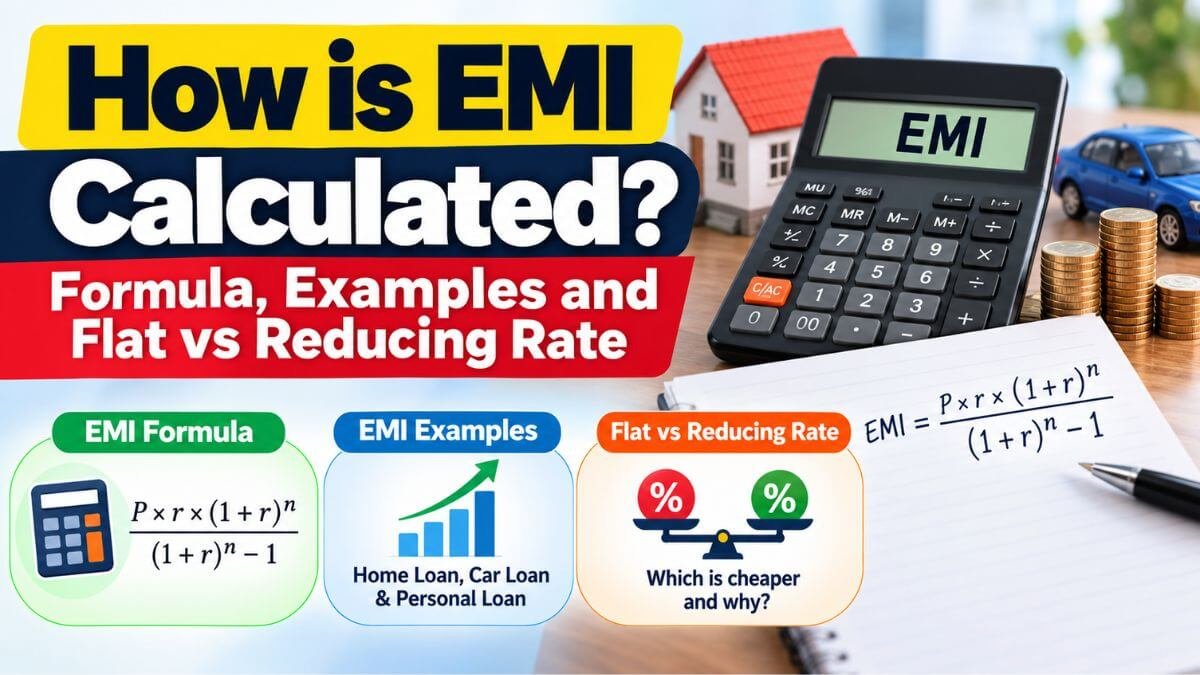
Before you take any loan, you should know how much you will pay every month and how much the loan will cost in total. That monthly payment is the EMI (Equated Monthly Instalment). This guide explains the EMI formula in plain steps, works through examples, and shows why a “flat rate” can be far more expensive than it looks.
Quick answer
- EMI = [P × r × (1 + r)^n] ÷ [(1 + r)^n − 1], where P is the loan amount, r is the monthly interest rate and n is the number of months.
- r = annual interest rate ÷ 12 ÷ 100.
- A longer tenure lowers your EMI but raises the total interest you pay.
- A flat interest rate costs much more than the same number quoted as a reducing-balance rate.
The EMI formula
EMI = [P × r × (1 + r)^n] ÷ [(1 + r)^n − 1]
- P is the principal, the amount you borrow
- r is the monthly interest rate (annual rate ÷ 12 ÷ 100)
- n is the number of monthly instalments
In Excel or Google Sheets, you can get the same answer with =PMT(annual rate ÷ 12, months, −loan amount).
Worked example
Suppose you borrow ₹1,00,000 at 12% a year for 12 months.
- Monthly rate r = 12 ÷ 12 ÷ 100 = 0.01
- EMI ≈ ₹8,885
- Total repayment ≈ ₹1,06,619
- Total interest ≈ ₹6,619
The EMI is the same every month, but the split between interest and principal changes. In the first month, interest is 1% of ₹1,00,000, which is ₹1,000, so about ₹7,885 of your EMI goes towards the principal. In the second month, interest is charged on the smaller remaining balance, so it falls to about ₹921 and more of the EMI goes towards the principal. Lenders may round figures slightly, so your actual EMI can differ by a few rupees.
Want to try your own numbers? Use our free EMI calculator to see your monthly Equated Monthly Instalment, total interest, a month-by-month repayment schedule and how extra monthly payments reduce your interest.
How tenure changes your cost
Take the same ₹1,00,000 at 12% a year:
| Tenure | Monthly EMI | Total interest paid |
|---|---|---|
| 12 months | ₹8,885 | ₹6,619 |
| 24 months | ₹4,707 | ₹12,976 |
Doubling the tenure nearly halves the EMI, but it almost doubles the interest. Choose the shortest tenure whose EMI you can comfortably pay.
For a bigger example, a loan of ₹5,00,000 at 11% a year for 5 years has an EMI of about ₹10,871. You would repay roughly ₹6,52,273 in total, of which about ₹1,52,273 is interest.
Flat rate vs reducing-balance rate
Some lenders and sellers quote a “flat” interest rate. Under a flat rate, interest is calculated on the full original loan amount for the whole tenure, even though you keep repaying the principal. Under a reducing-balance rate, interest is charged only on the amount you still owe.
Example: ₹1,00,000 for 3 years at a 10% flat rate.
- Interest = 10% × ₹1,00,000 × 3 = ₹30,000
- Total repayment = ₹1,30,000
- EMI = ₹1,30,000 ÷ 36 ≈ ₹3,611
The same EMI works out to roughly 17.9% a year on a reducing-balance basis. So a 10% flat rate is not 10%. Always ask for the reducing-balance rate or the annual percentage rate (APR), and compare loans on that.
What else adds to the cost?
The EMI formula covers only interest and principal. Also check for:
- Processing fee, and GST charged on it
- Late payment charges
- Prepayment or foreclosure charges
- Insurance or other add-on charges
RBI rules require regulated lenders to show the full cost of the loan, including the APR, in a Key Fact Statement before you accept. Read it.
How much EMI is too much?
There is no single rule, but a common guideline is to keep all your EMIs together under about 40% of your monthly take-home pay. Lenders also look at your existing obligations when they decide your eligibility. If your EMIs are already high, a new loan can push you into trouble, and a missed payment can hurt your credit score.
Short-term loans work differently. A payday loan is usually repaid in one payment and is quoted as a flat fee, so compare it with a personal loan in EMIs before you decide.
Tips to reduce the interest you pay
- Pick the shortest tenure you can afford
- Make part-prepayments when you have extra money, after checking the lender’s charges
- Keep a good credit score to qualify for lower rates (see how to improve your CIBIL score)
- Compare APRs from several regulated lenders, not just headline interest rates
FAQs
What is the EMI formula?
EMI = [P × r × (1 + r)^n] ÷ [(1 + r)^n − 1], where r is the monthly rate and n is the number of months.
Why does the interest part of my EMI fall over time?
Interest is charged on the outstanding balance. As you repay principal, the balance falls and so does the interest portion, while the EMI stays the same.
Is a flat rate cheaper than a reducing rate?
No. A flat rate looks lower but, for the same number, it works out to a much higher effective rate.
Does a longer tenure save money?
It lowers your monthly EMI, but you pay more interest overall.
Can I change my EMI after taking the loan?
Sometimes. Part-prepayment, a revised schedule or a balance transfer may be possible, depending on your lender and the loan terms.
This article is for general information and is not financial advice. The figures are illustrations based on the formula, not offers from any lender.