

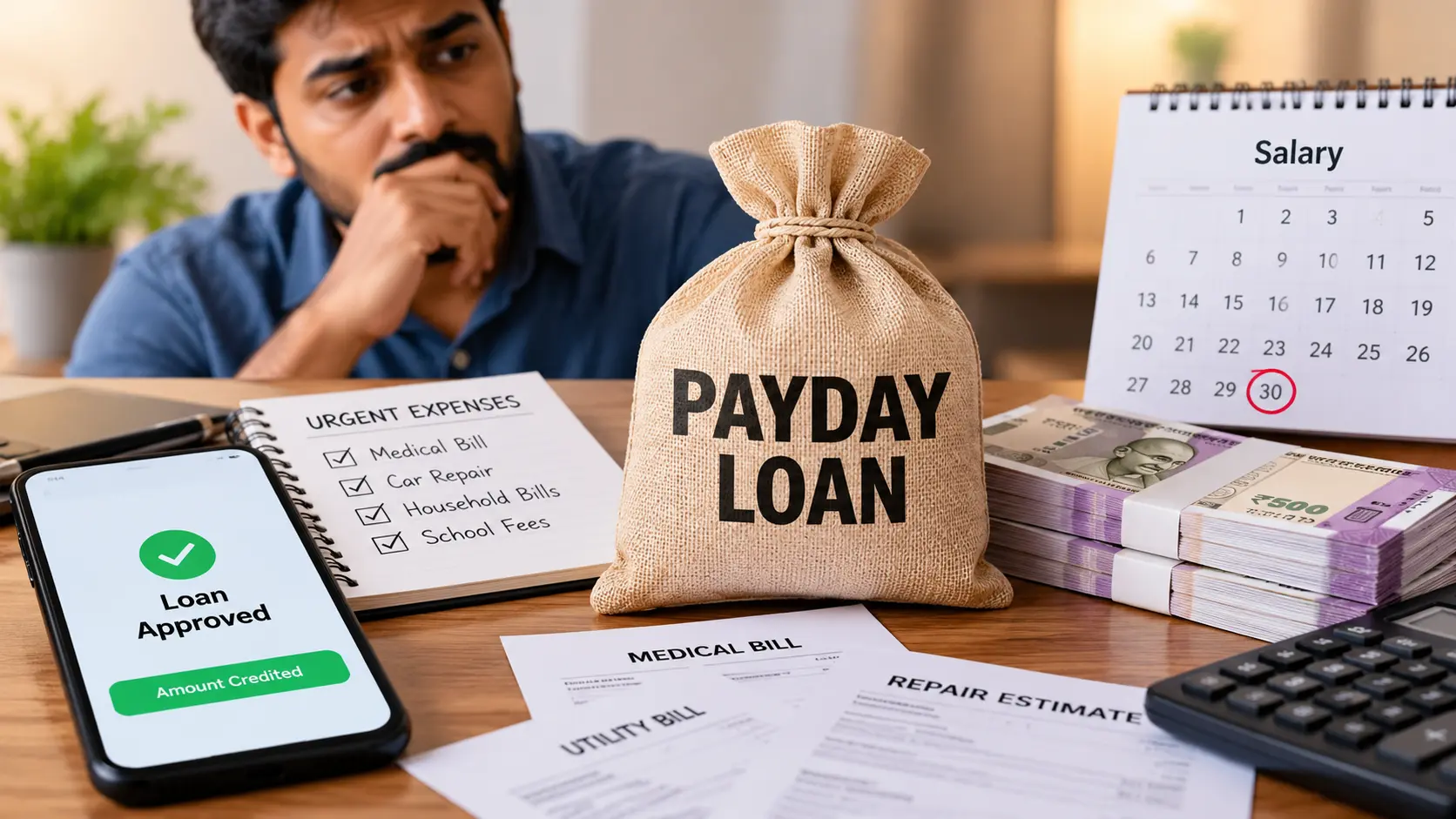
A medical bill, an urgent repair or a rent deadline can arrive a week before your salary does. A payday loan promises to bridge that gap quickly. It can work, but only if you know what it will really cost and are sure you can repay it on the due date.
Quick answer
- Check that the lender is an RBI-regulated bank or NBFC before you share any documents.
- A payday loan is a small, short-term, unsecured loan, usually repaid in one payment around your next salary date.
- Lenders usually ask for proof of identity, address and income. Salaried applicants with a regular income have the best chance of approval.
- The real cost can be very high. A flat fee that looks small can work out to over 100% a year once you annualise it.
- Missing the due date can add penalty charges and hurt your credit score.
What is a payday loan?
A payday loan is a short-term, unsecured advance meant to cover urgent expenses between two salary payments. Because it is unsecured, you do not have to pledge property, a vehicle or any other asset.
Depending on the lender, repayment is due within about two weeks, within a month, or around your next payday.
In India, “payday loan” is not a separate loan category defined by the RBI. These loans are usually short-term salary-advance or small personal loans offered by banks, NBFCs and other RBI-regulated entities, either directly or through lending apps that work with them.
How do payday loans work in India?
You can apply at a branch or through a lender’s app or website. The lender checks your KYC and verifies your employment and salary. If you are approved, the money is sent to your bank account, and you repay the principal, interest and any charges on the agreed date, usually as a single payment (a bullet repayment).
How much you can borrow usually depends on your monthly income. Some lenders offer roughly 30% to 60% of net monthly salary. Some banks also offer advance-salary loans to their own salary-account holders. For example, Kotak Mahindra Bank has described a one-month loan of up to 50% of net salary at a pre-approved rate for eligible customers. These limits are not universal, so always check the lender’s own terms.
Many loan apps are only a platform. The lender behind the loan must be a bank, an NBFC or another RBI-regulated entity, and RBI’s digital lending rules cover pricing, disclosures and recovery practices. The lender’s name should be clearly written in your loan agreement.
Who can get a payday loan?
The exact rules depend on the lender, but common conditions include:
- Indian resident
- Age 21 or above (some lenders also set an upper age limit)
- Full-time employment with a regular income
- A minimum monthly salary, often around ₹10,000 or more
- A stable employment record and a bank account where your salary is credited
Meeting these conditions does not guarantee approval. Each lender applies its own checks and policy.
What documents are required?
Payday lenders usually ask for documents that establish identity, address and income.
Commonly requested documents include:
| Purpose | Commonly accepted documents |
|---|---|
| Identity | Aadhaar, PAN, voter ID, driving licence |
| Address | Aadhaar, passport, recent utility bill |
| Income | Recent salary slips (often the last 3 months), bank statement showing salary credits |
| Employment | Employment proof or company ID, if asked |
| Other | Recent photograph or selfie for e-KYC |
The list differs between lenders, so check it before you apply.
How much does a payday loan really cost?
Payday loans are often quoted as a flat fee for the loan period, not as a yearly rate. That makes them look cheaper than they are. To compare them fairly, convert the fee into an annual rate:
Annualised rate = (Total charges ÷ Loan amount) × (365 ÷ Number of days)
Here is an example for a ₹10,000 loan repaid after 30 days:
| Total fee and interest for 30 days | Cost for the month | Approx. yearly rate |
|---|---|---|
| ₹500 | 5% | about 61% |
| ₹1,000 | 10% | about 122% |
| ₹2,000 | 20% | about 243% |
These figures are a simple illustration, not any lender’s actual rate. Headline interest rates vary widely between lenders, and processing fees, GST on those fees and late charges can push the all-in cost higher. RBI rules require regulated lenders to disclose the full cost of the loan before you accept it, usually in a Key Fact Statement. Read it, and compare the annualised cost, not just the fee.
Payday loan vs other options
| Option | Typical cost | Repayment | Watch out for |
|---|---|---|---|
| Payday or salary-advance loan | Highest per rupee borrowed | One payment within weeks | Short deadline; easy to roll into another loan |
| Personal loan | Usually a lower rate | EMIs over months or years | Slower approval, processing fee, stricter eligibility |
| Credit card purchase | Interest-free period if the bill is paid in full | Full payment by due date, or EMIs | High interest on unpaid balance; cash withdrawals are costly |
| Employer salary advance | Often little or no cost | Deducted from next salary | Depends on your employer’s policy |
| Family or friend | Usually none | Flexible | Can strain relationships; agree the terms clearly |
What happens if you miss the repayment?
- You may be charged a late fee or penal interest, as set out in your agreement.
- Your credit score can fall if the lender reports the delay to credit bureaus, which can make future loans harder or costlier to get.
- The lender can follow up for recovery, but it must follow RBI’s fair-practice rules.
The bigger trap is borrowing again to repay the first loan. Each new loan adds fees and a new deadline, and the debt grows quickly.
If you think you will miss the date, contact the lender before the due date and ask about an extension or a revised schedule. Do not take a second loan just to clear the first unless you have worked out the total cost.
How to spot an unsafe loan app
Illegal lending apps are a real problem in India. Be careful if an app:
- Does not clearly name the bank or NBFC that is giving the loan
- Asks for access to your contacts, photos or gallery
- Asks for an upfront “processing” or “insurance” fee before it sends the money
- Does not give you a written agreement or a clear summary of costs
- Uses pressure, threats or messages to your contacts to push you to pay
Before you borrow, check that the lender appears in the lists of banks and NBFCs on RBI’s website. The loan amount should come from the lender’s account into your bank account, and you should repay to the lender’s account.
If you face harassment, first complain to the lender’s grievance officer. You can then use RBI’s complaint portal (cms.rbi.org.in). To report fraud or extortion, call the national cybercrime helpline 1930 or use cybercrime.gov.in.
Is a payday loan right for you?
A payday loan can make sense only if all of these are true:
- It is a one-time, genuine short-term gap, not a regular monthly expense
- You know the total amount you will repay, including every fee
- Your salary will still cover rent, food and bills after you repay
- You do not already have other loans you are struggling to repay
- The lender is a regulated bank or NBFC
If even one of these is untrue, look at the alternatives in the table above first.
Also read | ChatGPT Virtual Try-On: Try Clothes Before Buying Online
FAQs
Is a payday loan legal in India?
Loans from RBI-regulated banks and NBFCs are legal, but there is no separate “payday loan” category. An app that is not tied to a regulated lender is a red flag.
Can I get a payday loan without salary slips?
Some lenders use bank statements or a salary account to verify income. Be wary of any lender that asks for no income proof at all.
Does a payday loan affect my credit score?
Many lenders report to credit bureaus. Paying on time can help your record, while missed payments can hurt it.
How much can I borrow?
It depends on your salary and the lender. Some lenders offer roughly 30% to 60% of net monthly salary.
What should I do if I cannot repay on time?
Contact the lender before the due date, ask for an extension or a new schedule, and avoid borrowing from another app to repay. If you face abuse or threats, file a complaint as described above.
This article is for general information and is not financial advice. Loan terms differ between lenders, so check the agreement and cost summary before you accept any loan.