

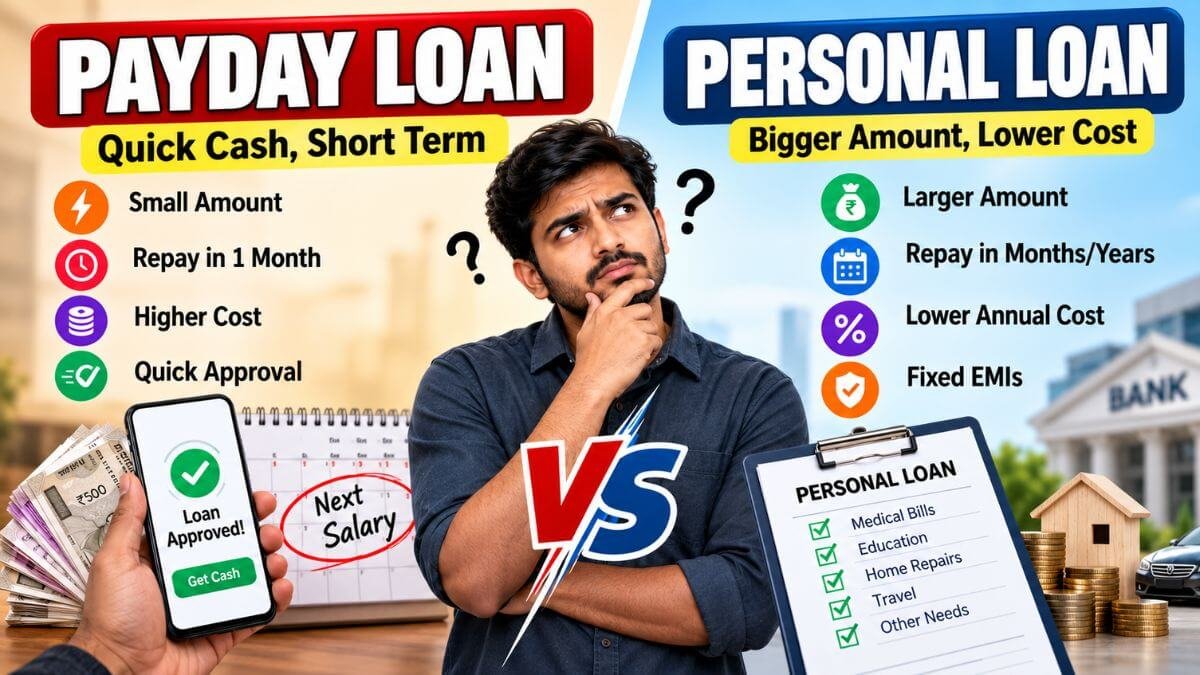
When you need money quickly, two options usually come up: a payday loan and a personal loan. Both are unsecured and both can be applied for online, so they can look similar. They work very differently, though, and the cost difference can be large. This guide compares them so you can pick the one that fits your needs.
Quick answer
- Choose a payday loan only for a small, one-time gap that you are certain you can repay in full on your next salary date.
- Choose a personal loan if you need a larger amount, more time to repay, or the comfort of fixed EMIs at a lower annual cost.
- Always compare the annualised cost, not the flat fee. A payday loan fee that looks small can work out to over 100% a year.
- If you are not sure you can repay on time, check cheaper options first.
Payday loan vs personal loan at a glance
| Feature | Payday loan | Personal loan |
|---|---|---|
| Loan amount | Small, usually a share of your monthly salary | Larger, based on your income and credit profile |
| Repayment period | Short: up to about a month, or around your next payday | Longer: usually several months to a few years |
| How you repay | One payment of principal, interest and charges | Monthly EMIs |
| Cost | Often a flat fee; can be very high when annualised | Annual interest rate plus processing fee; usually much lower when annualised |
| Approval speed | Often quick, sometimes the same day | Minutes to a few days, depending on the lender |
| Who qualifies | Salaried people with a regular income | Salaried or self-employed people with steady income and a decent credit record |
| Credit score | Some lenders weigh salary and employment more than the score | Usually matters a lot for approval and your interest rate |
| Best for | A small, one-time, short-term gap | Larger or planned expenses you want to spread out |
The details vary by lender, so treat this table as a general guide. For a full explanation of how payday loans work, read our guide to payday loans in India: eligibility, documents, interest and risks.
Which one costs less?
Payday loans are usually quoted as a flat fee for a short period, while personal loans are quoted as an annual interest rate. To compare them fairly, convert the payday fee into a yearly rate:
Annualised rate = (Total charges ÷ Loan amount) × (365 ÷ Number of days)
Here is an illustration for someone who needs ₹20,000:
| Payday loan | Personal loan | |
|---|---|---|
| Amount borrowed | ₹20,000 | ₹20,000 |
| Assumed charges | ₹2,000 fee for 30 days (10%) | 18% a year, plus 2% processing fee |
| Repayment | ₹22,000 in one payment after 30 days | 3 EMIs of about ₹6,868 |
| Total cost | ₹2,000 | About ₹1,000 (roughly ₹600 interest plus ₹400 fee) |
| Approx. yearly rate | About 122% | 18% interest, plus the fee |
These numbers are assumptions for illustration, not quotes from any lender. Real rates depend on the lender and on your credit profile. The point is that spreading repayment over a few months at an annual rate can cost far less than a short-term flat fee, and EMIs are easier to manage than one large payment.
Whichever you choose, add up processing fees, GST on those fees and late charges before you decide.
When a payday loan may make sense
- The amount is small and the need is genuinely one-time
- You know exactly how much you will repay, including every fee
- Your salary will still cover rent, food and bills after you repay
- You cannot get a personal loan or another cheaper option in time
- The lender is a regulated bank or NBFC (here is how to check if a loan app is RBI-registered)
When a personal loan is the better choice
- You need more than a month to repay, or more than your salary can comfortably cover in one go
- The expense is planned, such as medical bills, education, repairs or travel
- You have a reasonable credit score and can wait a little for approval
- You prefer fixed monthly EMIs
Other options to check first
- Employer salary advance: often little or no cost, and it is deducted from your next salary.
- Credit card: purchases come with an interest-free period if you pay the bill in full. Cash withdrawals usually cost much more.
- Loan against gold or a fixed deposit: often cheaper than an unsecured loan because the lender holds your asset as security. If you do not repay, the lender can recover its money from that asset.
- Family or friends: usually free, but agree the amount and date clearly to avoid strain.
Mistakes to avoid
- Comparing the flat fee instead of the annual cost
- Ignoring processing fees, GST and late charges
- Taking a second loan to repay the first. If you miss a payment, see how a missed EMI affects your credit score.
- Applying to many lenders at once, which can leave several credit enquiries on your report
- Borrowing from an app that is not linked to a regulated lender
FAQs
Is a payday loan cheaper than a personal loan?
Usually not. Personal loans are generally cheaper per year. A payday loan’s flat fee over a few weeks often works out to a much higher annualised rate.
Which one is easier to get approved?
Payday loans often have simpler checks and faster approval. Easy approval is not a reason to take one, though. Personal loans usually need a better credit profile.
Can I get a personal loan with a low credit score?
Sometimes, but you may get a smaller amount or a higher rate, or be turned down. A smaller loan or a co-applicant (if the lender allows one) can help.
Will either loan affect my credit score?
Both can. On-time repayment can help your record, while missed payments can hurt it.
Can I repay early?
It depends on the lender. Check the agreement for prepayment or foreclosure charges before you accept the loan.
This article is for general information and is not financial advice. Loan terms differ between lenders, so check the agreement and cost summary before you accept any loan.